
Home » Buying the IPO, Selling the Stock
Dear Reader,
Every month, a handful of headline numbers try to tell the whole story of the market. ‘Foreign investors are selling’ is one such headline, and it has been repeated often in recent weeks. I asked our research team to look past the daily flow figures this month and examine what foreign investors are actually doing with their capital in India, rather than simply whether they are net buyers or net sellers on a given day. What emerged is a more selective and, I think, more useful picture than the headlines suggest, with real implications for how we think about portfolio construction, concentration and opportunity. I hope you find this edition worthwhile.
Chairman and Founder
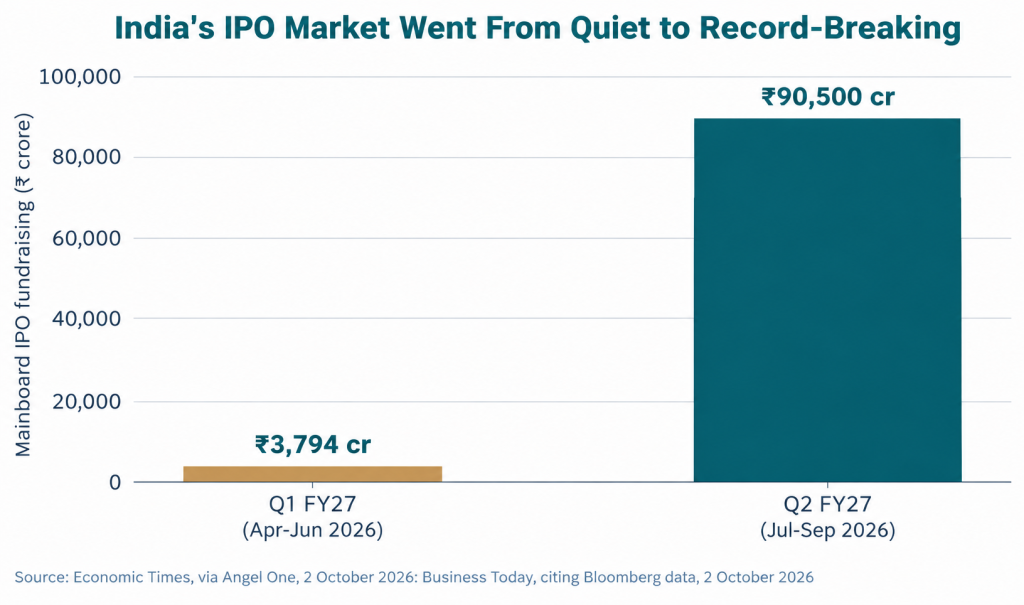
September 2026 was India’s busiest month for new stock market listings in nearly three decades. It was also, by some margin, the Nifty 50’s worst September in eight years. These two facts did not occur in spite of each other. They occurred, in large part, because of the same group of investors: foreign portfolio investors, who spent the month buying freshly listed shares while simultaneously selling shares they already held.
That single observation, once unpacked, tells us far more about the real state of foreign conviction in India than any single day’s net flow number ever could.
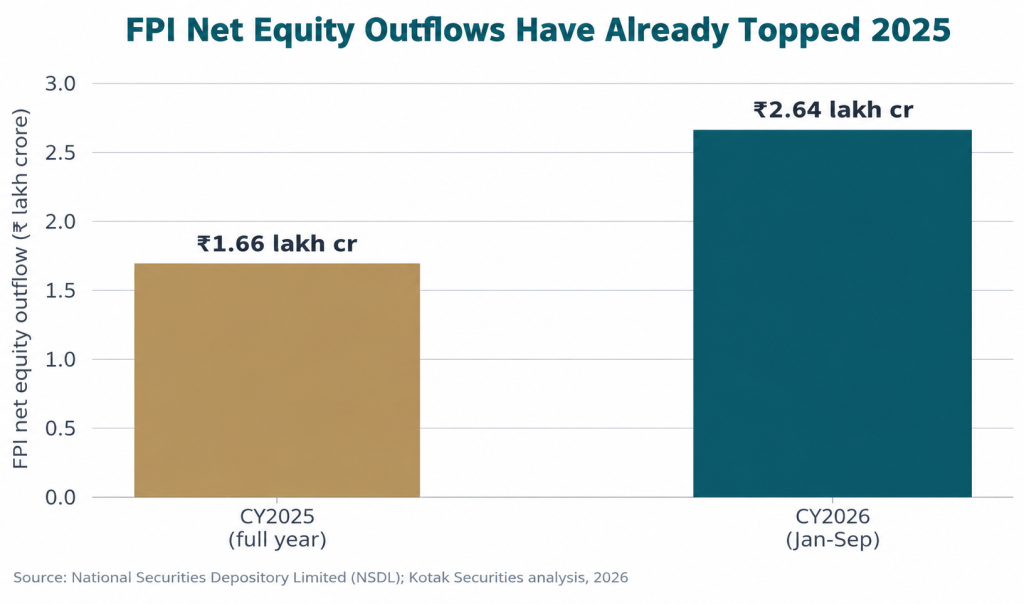
The conventional framing of foreign portfolio investor, or FPI, behaviour treats it as a single, binary signal: money is either coming into India or leaving it. On that framing, 2026 has looked grim. According to the National Securities Depository Limited, FPIs have been net sellers of Indian equities in every month of calendar year 2026 bar one, and cumulative outflows have run well ahead of the entire withdrawal recorded in calendar year 2025.
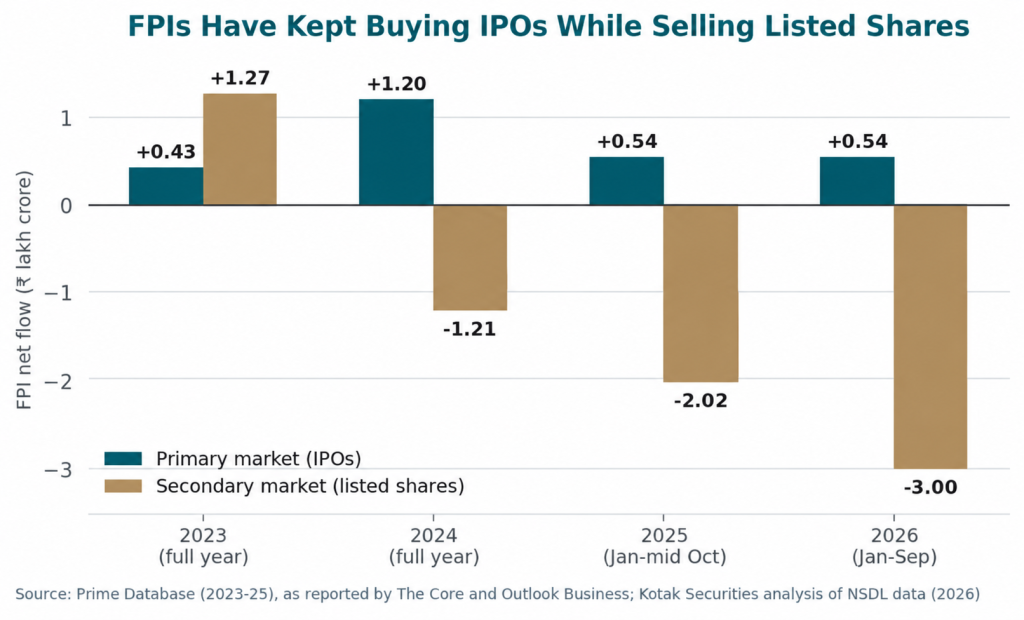
What this framing misses is that the same investors withdrawing from the secondary market, where existing shares change hands, have continued to put meaningful sums into India’s primary market, where new shares are issued through initial public offerings, or IPOs. This is not a new pattern. Prime Database, India’s primary market data provider, has observed this divergence building for three consecutive years. What is new in 2026 is the sheer scale of the primary market on offer, which has turned a modest divergence into one of the defining features of this year’s market.
The reason is mechanical as much as it is a matter of conviction. Buying a large stake in an already listed company through the open market can push the share price up against the buyer, an effect institutional investors call market impact. An IPO, or a qualified institutional placement, offers something the secondary market cannot: a fixed allotment, at a single price, agreed in advance. For a large global fund wanting to build a meaningful position in India without moving the market against itself, this is often the more efficient route in, regardless of its underlying view on India as a destination.
What investors may be misunderstanding, then, is the idea that a seller in the secondary market is, by definition, a sceptic on India. Many of the same institutions are doing both at once. The more accurate description of 2026 is not that foreign capital is leaving India. It is that foreign capital has become considerably more selective about the price and the route at which it is willing to enter.
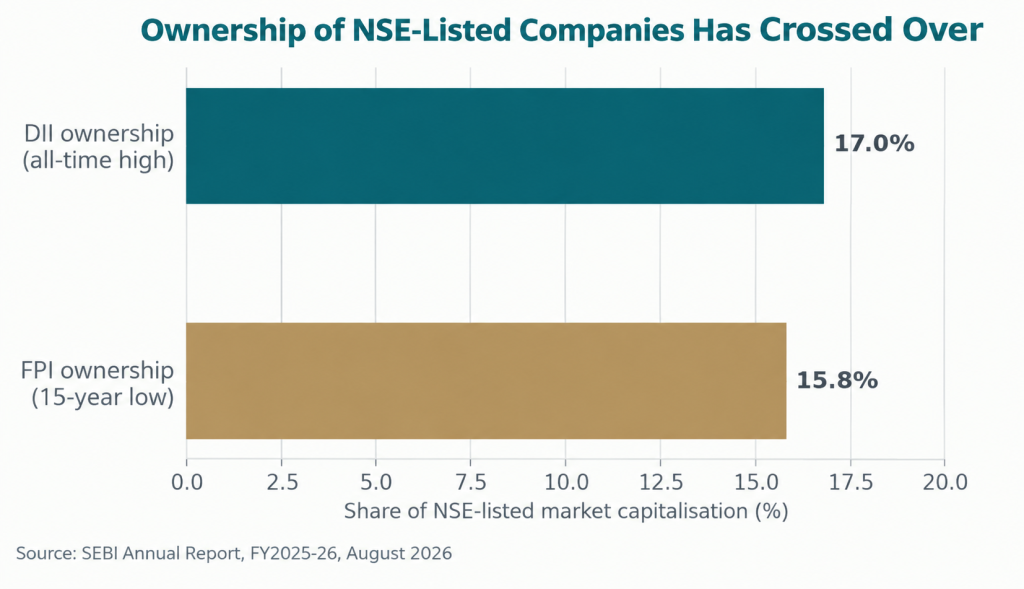
Each of these figures measures a slightly different period, financial year against calendar year, a single quarter against a cumulative total, and readers should take care not to conflate them. Taken together, however, they point consistently in one direction: a secondary market where foreign ownership is structurally declining, set against a primary market absorbing record sums, much of it from the very same investor base.
The pattern becomes clearer with a short history. In 2023, Prime Database data cited by financial commentators shows FPIs as net buyers in both markets at once, roughly ₹43,000 crore into the primary market and a further ₹1.27 lakh crore into the secondary market, a picture of broad conviction. By 2024, that conviction had narrowed to the primary market alone: FPIs invested close to ₹1.2 lakh crore in new issues while selling a similar amount of existing shares, leaving the two broadly offsetting. Between January and mid-October 2025, the gap widened sharply: FPIs invested ₹54,178 crore in IPOs, including large listings such as Tata Capital and LG Electronics India, while selling ₹2.02 lakh crore of shares already in issue. The gap has widened further still in 2026: between January and September, FPIs put just over ₹54,000 crore into new issues while selling more than ₹3 lakh crore of listed shares in the secondary market, by some distance the widest split on record.
Within September 2026 itself, NSDL sector data shows FPI secondary market selling concentrated heavily in financial services and automobiles, the two sectors that carry the highest foreign ownership and the deepest secondary market liquidity, which is precisely why they are the easiest place for a large investor to raise cash quickly when rebalancing a portfolio.
Domestic institutions, meanwhile, have been the steady counterparty throughout. Monthly inflows through systematic investment plans, or SIPs, have remained above ₹30,000 crore in recent months, giving Indian mutual funds a continuous, largely rate-insensitive pool of capital to deploy against foreign selling, regardless of the news cycle.
What is changing: this sector has absorbed the largest share of FPI secondary market selling through 2026, precisely because it is the most liquid and most heavily foreign-owned part of the index. What it means for earnings: credit growth and asset quality at most large banks have not deteriorated to a degree that would justify the scale of selling on fundamentals alone. What the market may be mispricing: the risk that this is read as a verdict on Indian banking, when it may be better read as a liquidity and rebalancing decision. The key risk: if global rates stay elevated for longer, this selling could persist regardless of improving fundamentals, keeping valuations compressed for a while yet.
What is changing: the current IPO pipeline is bringing a different kind of company to market compared with the listed index, which has historically been dominated by financials, information technology and consumer staples. Names such as the National Stock Exchange itself, together with other large platform and financial infrastructure businesses, give investors exposure that was previously unavailable in the listed secondary market. What it means for earnings: these are, in several cases, well-established, profitable businesses rather than early-stage ventures, a point several market participants have made in noting that the share of profitable companies at the time of listing has risen over recent years. What the market may be mispricing: a pipeline of this size, ₹3.86 lakh crore and growing, will keep competing with existing listed shares for investor cash well into 2027, a liquidity effect that has little to do with the quality of any individual business. The key risk: at this pace of issuance, pricing discipline becomes harder to maintain, and not every forthcoming listing will deserve its anchor book.
What is changing: IT services shares have seen intermittent FPI buying and selling through 2026 rather than a one-directional move, reflecting genuine uncertainty rather than conviction in either direction. What it means for earnings: the sector’s traditional growth model, built on expanding headcount at a low cost relative to developed market peers, is being tested by the productivity gains large clients are now demanding from artificial intelligence tools, a dynamic that cuts both ways for revenue and margins. What the market may be mispricing: the risk that near-term earnings stability is read as evidence the structural question has been resolved, when it has arguably only begun. The key risk: a sector repricing driven by a multi-year change in the hiring and billing model, not a single quarter’s results.
For long-term investors, the practical lesson is not to treat a headline FPI outflow figure as a verdict on India as an asset class. A meaningful part of this year’s foreign selling appears to be a liquidity and rebalancing decision rather than a reassessment of the country’s long-term prospects, and reacting to it as though it were the latter risks selling good businesses on a technical signal.
This may warrant a closer look at diversification across market capitalisation rather than a reflexive retreat into the largest, most heavily foreign-owned names during periods of FPI selling, since that selling has tended to concentrate in a small number of liquid sectors rather than reflect a broad judgement on quality.
For portfolios with access to pre-listing or anchor allocations, the scale of the current pipeline is a genuine diversification opportunity into businesses not otherwise available through the listed market, though the sheer volume of supply argues for more rigorous selection, not less. Oversubscription on its own is a weak signal of quality when the number of large, well-funded institutional bidders in the market has grown substantially.
For family offices and multi-generational portfolios, the broader implication is structural rather than tactical. India’s domestic savings base, through SIPs, insurance and provident funds, has become large enough to absorb substantial foreign selling without the market breaking down, a resilience that did not reliably exist a decade ago. This does not remove the case for maintaining some allocation to global, non-rupee assets as a standing diversifier. It does suggest that the Indian equity market’s dependence on foreign sentiment for its day-to-day direction is gradually, structurally, easing.
The prevailing narrative treats sustained FPI selling as a loss of foreign confidence in India. This likely overestimates how unified or directional FPI behaviour actually is, when the same cohort of investors is simultaneously placing record sums into the country’s primary market. It likely underestimates how much of 2026’s selling reflects valuation discipline and market mechanics, the ease of raising cash in liquid, richly owned sectors, rather than a reassessment of India’s medium-term growth prospects.
For the bearish reading to be correct, one assumption needs to hold: that FPIs see something in India’s secondary market outlook that leads them to reduce exposure to existing businesses, while that same view does not apply to the new businesses they are concurrently buying into at IPO. The evidence for that specific, narrower claim is considerably weaker than the evidence for a simpler explanation, that a historic supply of attractively structured new paper is drawing capital away from an already well-owned secondary market.
The record IPO rush of September 2026 and the Nifty’s worst September in eight years were not two separate stories. They were two expressions of the same underlying development: foreign capital becoming more selective about price and route, not more sceptical about India. For the long-term investor, the sensible response is not to read a difficult month in the secondary market as a verdict on the country, nor to treat every new listing as automatically superior simply because it arrives with a full anchor book. The discipline that matters, as it always has, is judging each opportunity, new listing or existing holding, on its own fundamentals and its own price.
Particulars | 01st Sep 2026 | 30st Sep 2026 | HIGH | LOW |
BSE S&P SENSEX | 76,994.11 | 72,480.29 | 77,231.87 | 72,064.00 |
NIFTY 50 | 24,077.55 | 22,620.45 | 24,143.15 | 22,569.65 |
(INR. In Lakh Crore)
Particulars | AUM As On 31-07-2026 | Fresh Fund Mobilize During Aug–2026 | Redemption During Aug–2026 | AUM As On 31-08- 2026 |
Total AUM of all mutual funds scheme | 86.50 | 14.09 | 13.67 | 86.92 |
AUM of equity oriented (growth) schemes | 38.91 | 0.74 | 0.44 | 39.21 |
Source: Association of Mutual Fund of India (AMFI)
(INR. In Lakh Crore)
Month | SIP Contribution | SIP AUM Aug-2026 |
Aug–2026 | 32,297 | 18,61,652 |
(INR. In Lakh Crore)
Particulars | Gross Purchase | Gross Sale | Net |
FII | 3.14 Lakh | 3.58 Lakh | (0.44 Lakh) Selling |
DII | 3.68 Lakh | 2.92 Lakh | 0.76 Lakh Buying |
Disclaimer
This newsletter is prepared for informational and educational purposes only and does not constitute investment, legal or tax advice, nor a recommendation to buy, sell or hold any security or asset class. It does not take into account the individual financial circumstances, objectives or risk tolerance of any reader. Past performance is not indicative of future results. Readers should consult their own advisers before making investment decisions.
Sources: Business Standard (30 September 2026); Ventura Securities and DSIJ (30 September 2026); Business Today, citing Bloomberg data (30 September 2026 and 2 October 2026); Economic Times, via Angel One (2 October 2026); Whalesbook (September and October 2026); Kotak Securities analysis of National Securities Depository Limited (NSDL) data (2026); SEBI Annual Report, FY2025-26 (August 2026); Prime Database commentary as reported by The Core and Outlook Business (2025-26); finnovate.in NSDL-linked sector data (September 2026).
Figures above are drawn from regulatory sources where cited and from financial news reporting of NSDL and SEBI data elsewhere. Flow figures vary slightly across reporting periods and sources owing to differing cut-off dates and methodology, and readers should treat approximate figures as indicative rather than final.