
Home » Family Offices in India: Do You Need One Yet?
We live in an era of unprecedented wealth creation in India. What was once the preserve of a small number of business dynasties is now a reality for a growing number of entrepreneurs, promoters, and professionals across the country. Yet with that wealth comes a set of challenges that few are fully prepared for.
Over the past two decades, I have seen firsthand how the absence of structure can quietly erode what takes a lifetime to build. Families that spent years creating wealth have found themselves vulnerable during succession, caught off-guard at liquidity events, or struggling to coordinate advisors who each held only a fragment of the whole picture.
This edition addresses one of the most important structural decisions a wealthy family can make: whether the moment has arrived to formalise how their wealth is managed, protected, and eventually transferred.
This edition addresses one of the most important structural decisions a wealthy family can make: whether the moment has arrived to formalise how their wealth is managed, protected, and eventually transferred.
We do not believe there is a single right answer for every family. But we do believe that asking the question with rigour, and at the right time, is an act of stewardship.
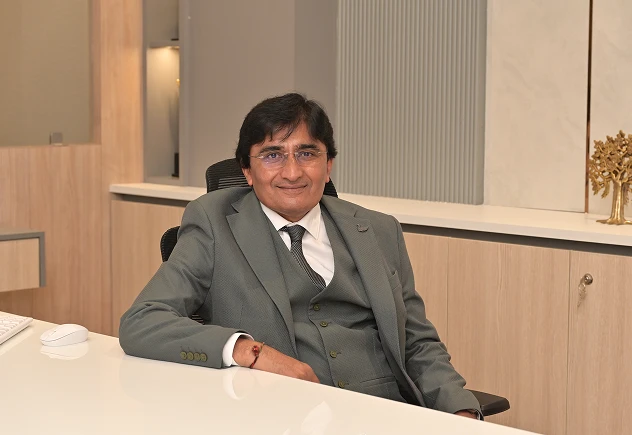
Chairman and Founder

Managing ₹5 crore and managing ₹500 crore are fundamentally different propositions. At the lower end, a good financial advisor, a tax consultant, and a reliable chartered accountant are typically sufficient. As wealth scales, however, the picture changes entirely.
Becomes only one layer of a far more intricate structure — no longer the sole focus.
Across multiple entities, jurisdictions, and asset classes demands coordinated expertise.
Across family branches requires frameworks no single advisor can provide.
Singapore, UAE, US, and Europe create regulatory complexity requiring dedicated oversight.
At a certain point, piecemeal advice from independent professionals is no longer adequate. It becomes expensive, disorganised, and prone to critical gaps.

| Category | Investable Assets |
|---|---|
| HNI | ₹5 crore or more |
| VHNI | ₹5 crore – ₹25 crore |
| UHNI (India) | ₹25 crore+ |
| UHNWI (Global) | USD 30M+ (~₹250 crore) |
The two benchmarks measure very different populations. Conflating them leads to a significant underestimation of the opportunity.
The term “family office” is often used loosely, but there are two distinct models.
A private entity established exclusively to serve one family. It employs a dedicated team of professionals, manages all aspects of the family’s financial and non-financial affairs, and operates entirely under the family’s control. The costs are borne entirely by the family. SFOs are generally considered viable from a cost perspective when investable assets exceed ₹500 crore, though the threshold varies with the complexity of the family’s affairs.
A professional firm that serves multiple wealthy families under a shared structure. It offers most of the same capabilities as an SFO but distributes the cost across several clients, making it accessible at lower wealth thresholds, typically from ₹50 crore to ₹500 crore in investable assets.
Consider a promoter family with a listed company, several unlisted subsidiaries, residential and commercial real estate in three cities, a venture portfolio accumulated over a decade, NRI family members with foreign assets, and an impending generational transition. This family likely deals with five to eight independent advisors, none of whom has a complete picture of the whole.
According to the EY-Julius Baer study, governance frameworks and structured succession plans are now increasingly central to how Indian family offices operate — with growing adoption of formal instruments such as trusts, wills, and family constitutions.
41% No Succession Plan Of wealthy Indian families still have no formal succession plan in place — underscoring how much ground remains to be covered.
Some of India’s most prominent wealth holders have structured their affairs through dedicated family offices. The approaches they have taken offer instructive lessons for families considering the same path.
Established in 2006 by Azim Premji, it is among the most professionally run family offices in Asia. Operating from Bengaluru, it has built a diversified portfolio spanning technology, healthcare, consumer goods, and financial services — with investments including Flipkart and Lenskart. In early 2024, it received inprinciple approval from GIFT City to set up a Family Investment Fund for overseas deployment. Its distinguishing characteristic is institutional rigour: operating with the discipline of a professional investment firm while serving one family’s capital and philanthropic mission.
Founded in 2010 by N.R. Narayana Murthy, co-founder of Infosys, Catamaran manages a portfolio across private equity, public equities, venture capital, and international investments. Its holdings span sectors from aerospace contract manufacturing to agritech and digital media, and include investments outside India such as SpaceX. What is notable is the breadth of its mandate — reflecting the full range of asset classes a properly structured single-family office can pursue, well beyond what a conventional wealth manager would access.
The personal family office of Ratan Tata, established in 2009, became well known for active participation in India’s early startup ecosystem — backing Ola, CarDekho, Paytm, and Urban Ladder at a time when institutional capital for earlystage businesses was scarce. RNT demonstrates a different model: a family office deployed not primarily for returns optimisation but as a vehicle to express convictions, build relationships, and engage purposefully with new areas of the economy.
A common thread across all three: the decision to professionalise early. Each brought in dedicated investment professionals rather than relying on generalist advisors. Each built processes, not just portfolios.
For founders who have recently experienced liquidity events through IPOs or private equity sales, the lesson is clear. The window between receiving proceeds and deploying them without structure is precisely when poor decisions, tax inefficiencies, and governance failures tend to occur.
There is no single threshold that answers this question. The decision depends on a combination of factors. Use the following framework to assess your position.
Multi-Family Office (MFO): Investable assets between ₹50 crore and ₹500 crore. Moderate family complexity. Preference for professional management over an internal team. Access to a broad specialist network without bearing full employment costs.
Single Family Office (SFO): Investable assets exceeding ₹500 crore. High complexity across entities, geographies, and generations. Requirement for maximum control and customisation. Cost of a dedicated team is justified by depth of service.
The decision between an SFO and an MFO is largely one of scale and control. A well-run MFO delivers most of the benefits at a fraction of the overhead for families below the ₹500 crore threshold.
A well-structured multi-family office is accessible and relevant to families with ₹50 crore or more in investable assets. The services — consolidated reporting, coordinated tax planning, estate structuring — are just as valuable at this level.
Investment management is one function among many. Its more durable value lies in succession planning, governance, and coordination across generations. Families that set one up purely to manage a portfolio are underutilising the structure.
It does not. A family office coordinates advisors — legal counsel, chartered accountants, investment managers, tax specialists, and trustees. It provides the oversight and integration that individual advisors cannot offer on their own.
Some of the most consequential decisions are made during peak wealth-creation years — at a liquidity event, at IPO, or at the inception of a PE transaction. Waiting until retirement means absorbing the full cost of disorganisation when the stakes are highest.
The question facing India’s wealthiest families is no longer whether they need investment advice. Most already have it, in some form. The real question is whether they have the structure required to coordinate, protect, and transfer wealth efficiently across generations
India is entering a decade of unprecedented wealth transition. The founders who built the country’s great businesses over the past 30 years are approaching the stage at which capital must pass to the next generation. A USD 1.3 trillion wealth transfer, per the EY-Julius Baer study, will unfold over the next ten years. Much of it will be smooth and well-governed. Some of it will be contested, inefficient, and costly.
The difference, in most cases, will come down to structure.
A family office, whether single or multi, is not a luxury. For families at the threshold of complexity, it is the foundation on which everything else rests.
| Indices | 01-05-2026 | 31-05-2026 | High | Low |
|---|---|---|---|---|
| BSE S&P SENSEX | 77,257.27 | 74,775.74 | 78,384.70 | 74,134.48 |
| NIFTY 50 | 24,063.55 | 23,547.75 | 24,482.10 | 23,262.55 |
| Particulars | AUM As On 31-03-2026 | Fresh Fund Mobilize During April-2026 | Redemption During April-2026 | AUM As On 30-04-2026 |
|---|---|---|---|---|
| Total AUM of all mutual fund schemes | 78.45 | 15.20 | 11.93 | 81.72 |
| AUM of equity oriented (growth) schemes | 35.36 | 0.70 | 0.32 | 35.74 |
(INR. In Lakh Crore)
Source: Association of Mutual Fund of India (AMFI)
| Month | SIP Contribution | SIP AUM |
|---|---|---|
| April-2026 | 31,115 | 16,85,126 |
(INR. In Lakh Crore)
| FII / DII | Gross Purchase | Gross Sale | Net |
|---|---|---|---|
| FII | 3.54 Lakh | 4.10 Lakh | (0.56 Lakh) |
| DII | 3.61 Lakh | 2.79 Lakh | 0.82 Lakh |
(INR. In Lakh Crore)